Understanding Dog Body Language
As wonderful as the world would be if our dogs could talk to us, unfortunately, that is not the case. But that’s not to say they’re not trying to communicate with us. Dogs have a vast range of vocal and body language to show us how they’re feeling, and here we talk about what each of those things means.
Contents:
- Dogs' tail meanings
- Signs of Anxiety in Dogs
- Signs of a Happy Dog
- How to Tell if Your Dog is in Pain
- Aggressive Behaviours in Dogs
Why Do Dogs Wag Their Tails?
The best way to decipher your dog’s emotions is to look at their tail. Have you ever called your dog’s name and had them run up to you, tail wagging? That’s because a wagging dog tail is a clear sign that your dog is happy, excited and glad to be with you. And not only that, but your dog’s tail can convey a wide range of emotions, which we cover here.
Dogs' Tail Meanings
The language of tail wagging goes beyond just the height of your dog’s tail and the speed at which it wags. Generally speaking, the faster the wag, the happier the dog. Some dogs have even been known to injure their tails from wagging too enthusiastically, which is called Happy Tail Syndrome.
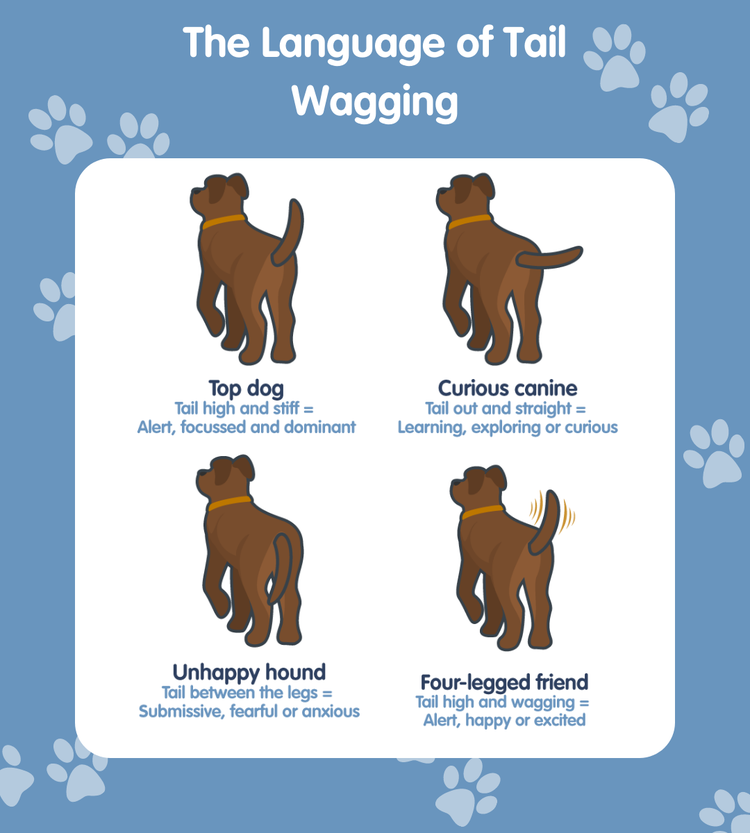
- Tail high and focused: This is a sign that your dog is alert and confident in itself and its surroundings. Your dog’s tail may be like this when greeting a new dog to show its dominance.
- Tail out and straight: This is a sign your dog is curious and may even be coupled with raising its front paw to show interest in something. Some breeds, such as Pointers, will stick their tail out this way to let their owner know they have found something, which is how they got their name.
- Tail between their legs: The most obvious reason for this stance is that your dog is afraid or anxious. More anxious dogs will likely do this more often, but it may be a sign of submission if your dog knows they have done something wrong or may even be followed by your dog flopping over on their back for a belly rub.
- Tail High and wagging: This is your dog’s way of showing that it is alert, happy, and very excited. You’ll often see your dog’s tail like this during playtime or when you come home after work.
If you’d like to see what your dog’s tail would look like in these scenarios, refer to our dog body language chart.
Signs of an Anxious Dog
If your dog is stressed or anxious, you can usually tell through the changes in their body language and behaviour. A stressed dog will often:
- Keep their body and their head low.
- Keep their tail tucked under or swaying very slowly from side to side.
- Avoid eye contact or turn their head away.
- Hold their ears back.
- Whimper.
Our guide to anxiety in pets explains the behavioural signs of a stressed or anxious dog, as well as advice on how you can help them feel more at ease.
Signs of a Happy Dog
If your dog is happy, you’re definitely going to know about it. Happy dogs are always ready for play or some fuss, so they will likely do all they can to be near you, sometimes even sitting on your lap (no matter their size). Some other signs your dog are happy include:
- Having a relaxed posture with smooth hair.
- Mouth open and relaxed, and ears in a neutral position.
- Wagging tail.
- Raising their bum in the air to indicate they want to play.
- Barking excitedly.
- Interested and alert facial expression with wide-open eyes.
If your dog is in a happy or playful mood, it's the perfect time to bring out their favourite dog toys and give them all the fuss and love they deserve.
How to Tell if Your Dog is in Pain
The signs of a dog in pain can be very similar to those of an anxious dog, and the only real way to be sure if your dog is in pain is to take them to a vet to be professionally examined and treated. That said, some signs your dog is in pain may be:
- Refusal to play.
- Refusal to be touched or petted in the affected area or at all.
- They’re spending a lot of time lying down with their ears back.
- Whimpering, especially if the affected area is touched.
- Keeping their weight off the affected area by limping or raising their paw.
Changes in behaviour can also accompany illness and pain in dogs and may give you some indication of what’s wrong, such as:
- Not eating could be a sign of pain in the mouth or throat, such as gum disease, or it could be a sign of other conditions.
- Having trouble walking, climbing stairs, or playing could be a sign of pain in your dog’s joints or muscles, such as arthritis. Sometimes this can be helped with regular dog joint supplements, but be sure to speak with your vet beforehand in case more intensive treatment is required.
- Vomiting or diarrhoea could be a sign that your dog has problems with their stomach or gastrointestinal tract, such as unbalanced gut bacteria or something more severe. Introducing dog probiotics could help solve this issue, but getting a vet's advice is always best in case something else is wrong.
If you notice any of the above or any other changes in your dog’s behaviour or body language, consult your vet as soon as possible. In many cases, the sooner the problem is identified, the easier it is to treat.
Aggressive Behaviours in Dogs
Aggression in dogs can result from a number of things and is not specific to individual breeds, although some may have inherited some aggressive tendencies that need to be controlled with proper (if not professional) training and socialisation.
Aggression in dogs can manifest in several ways. Still, there is a distinction between a fearfully aggressive dog and a dominantly aggressive dog, both of which require different methods of handling.
A fearfully aggressive dog is likely trying to scare you away so as not to be hurt, and this may be because the dog is in pain or has suffered a trauma of some kind. Fearful aggression often shows itself through the following body language:
- The body is low to the ground
- Hackles raised (hair standing on end)
- Nose wrinkled back in a slight growl
- Ears back
- Dilated pupils
A dominant, aggressive dog, however, tends to have the following body language:
- Standing stiff-legged with their body angled forward.
- Nose and forehead wrinkled.
- Lips drawn back to show teeth.
- Ears forward.
- Hackles raised.
- Tail up and stiff, sometimes seeming to vibrate.
Please remember that there can be a number of reasons why your dog is displaying signs of aggression, such as being afraid or in pain. It is always best to have your dog checked by a vet or dog behavioural specialist to find the root of the problem, so you can figure out a solution.
Understanding your dog’s body language is a crucial part of dog ownership and a great way to feel more connected to your dog! We all want our pets to be happy and healthy, and understanding their needs and recognising any changes to their behaviour is the first step in ensuring they stay as happy as possible.
If you’re concerned about your dog’s behaviour, consult your vet. If your dog is anxious or stressed, however, some options are open to you, including a range of dog anxiety treatments available without a prescription. If you’d like to learn more about these, please contact us, and a member of our friendly team will be happy to help.

This post is an opinion and should only be used as a guide. You should discuss any change to your pet’s care or lifestyle thoroughly with your vet before starting any program or treatment.
