
Tapeworms in Cats & Dogs: Symptoms & Treatments
The first step to fighting any parasite infection is to know what you’re up against. Tapeworms are one of the most common intestinal worms found in the UK. They're often spread through other animals, such as livestock or wildlife, before being ingested (usually accidentally) by their prime host—your pet.
Below, you can learn more about how tapeworms infect your pet and how to treat and prevent them.
Areas of Interest:
- Types of tapeworms in cats & dogs
- Where do pets get tapeworms?
- Signs your pet has tapeworms
- Treating your pet for tapeworms
What Are Tapeworms?
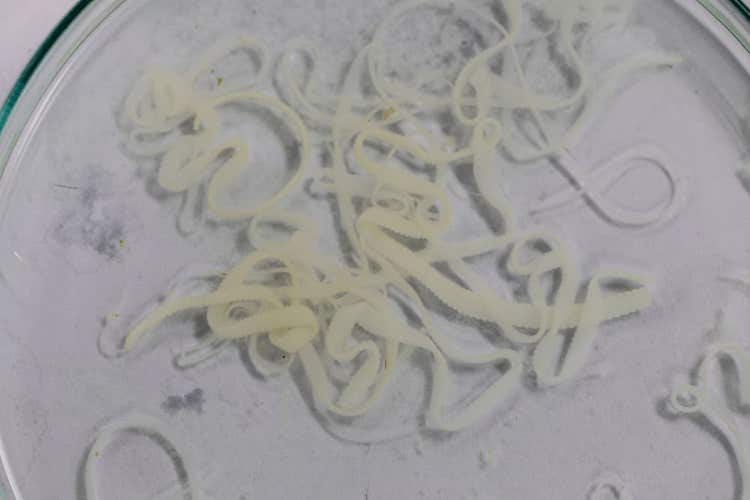
As the name suggests, tapeworms are long, flat worms that look like a pale strip of tape or ribbon, and there are multiple types of tapeworms depending on the animal they’re infecting, which we explore below.
Tapeworms have a sharp, sucker-like mouth (scolex) to latch onto the gut wall and live off the nutrients from the animal’s diet. Here are some of the key things that set tapeworms apart from other parasitic worms:
- Tapeworms are hermaphroditic, meaning they have both male and female reproductive organs.
- Tapeworms are segmented worms, and each segment (proglottid) contains a complete set of reproductive organs.
- Tapeworms don’t have a digestive system, but instead absorb all their stolen nutrients directly through their outer surface.
- Segments of tapeworms detach as the worm grows (which is often what you see in your pet's faeces) and are released into the environment through the faeces of their host, so their eggs can spread to their next host.
- Tapeworms require two hosts to complete their lifecycle. The intermediate host consumes the eggs and houses the immature stages of the worms before being consumed by the definitive host, where adult worms develop and continue the life cycle.
How Common are Tapeworms in the UK?
The infection rate for tapeworms in pets varies depending on your pet’s risk factor, but studies by the brand Vetoquinolfound that a large majority of dog owners weren’t aware of the risk tapeworms pose, not just to their pet, but to livestock across the country.
After asking 1,000 dog owners, the study found:
- 54%* treated their dog for tapeworms
- 36%* were more likely not to pick up after their dog in rural fields
- 64%* did not think about what could be left behind if they didn't pick up after their dog
- 51%* were unaware of the impact tapeworms can have on livestock
This study provides us with better insight not just into the impact of tapeworms, but also the continued spread of these parasites and the damage they can cause to both pets and livestock.
How to Prevent the Spread of Tapeworms
We can all do more to prevent the spread of tapeworms by being properly informed about the type of tapeworms that pose a risk to animals throughout the UK and the importance of a complete worming routine.
The key things you can do to stop the spread of tapeworms include:
- Treating your pet routinely for tapeworms (at least once every three months)
- Treating your pet for fleas regularly (at least once a month, depending on treatment)
- Always clean up after your dog, especially when walking through rural areas or places near livestock.
- Regular vet visits can also be important in the early identification of tapeworm infestations.
By following these simple steps, you can help reduce the risk of your pet becoming infected with tapeworms and also reduce the spread of these damaging parasites.
Types of Tapeworm
Tapeworms are not a single worm; instead, they encapsulate various species of parasitic worms that impact different animals depending on their intermediate and definitive hosts.
Below, we explore what species of tapeworms are a risk to which pets according to the European Science Counsel for Companion Animal Parasites, either as an intermediate or definitive host, and how their life cycle is completed.
Tapeworms in Dogs
- Dipylidium caninum
- Taenia species
- Echinococcus granulosus
- Echinococcus multilocularis
Tapeworms in Cats
- Dipylidium caninum
- Taenia taenaieformis
Tapeworms in Horses
- Anoplocephala perfoliata
- Anoplocephala magna
- Anoplocephaloides mamillana
Tapeworms in Small Pets
- Taenia serialis (intermediate host)
- Taenia pisiformis (intermediate host)
- Hymenolepis nana (Hamsters)

How Do Pets Get Tapeworms?
How your pet might pick up tapeworms depends on the species they’re prone to. Most tapeworms require two separate hosts to complete their life cycle:
- A definitive host that carries the mature tapeworm, which continues to release eggs into the environment.
- An intermediate host that picks up eggs from the environment and carries the immature life stages of the worm.
For example, Dipylidium caninum is the most common tapeworm species in cats and dogs. They are transmitted through fleas (their intermediate host). The immature tapeworm eggs live inside fleas, which are commonly ingested by pets who groom themselves during a flea infestation.
This is why ensuring you treat your pet for fleas is an essential step in any worming routine.
Below, we explore the places where pets can pick up each type of tapeworm and whether or not they’re zoonotic (transferable to humans).
Perhaps the most common tapeworm in the UK is the Dipylidium caninum (or flea tapeworm), which is often found in cats and dogs. However, it can occasionally be found in humans.
The eggs for this type of tapeworm are excreted in the affected animals' faeces, where they are typically picked up after being ingested by flea larvae. That flea larva then grows into an adult flea, now infected with immature tapeworm larvae.
If your pet ingests an infected flea (most often through grooming while infested with fleas), the tapeworm larvae will make their way to your pet’s digestive system, where they will mature into an adult tapeworm, starting the life cycle over again.
There are multiple taenia species, but the risk of your pet becoming infected depends on the parasite’s intermediate host and your pet’s access to it. The key tapeworms in the Taenia species include:
- Taenia solium (Humans and dogs - spread through infected pigs)
- Taenia saginata (Humans and dogs – spread through infected cows)
- Taenia hydatigena (Dogs – spread through livestock or deer)
- Taenia taeniaeformis (Cats – spread through mice or rats)
- Taenia multiceps (Dogs – spread through sheep)
- Taenia crassiceps (Dogs – Spread through rats and mice)
- Taenia serialis (Dogs – spread through rabbits)
- Teania pisiformis (Dogs – Spread through rabbits)
The definitive hosts for these worms tend to be humans and dogs, but some can infect cats as well.
The intermediate hosts for each of these worms vary, with some infecting livestock (such as cows, sheep, and pigs) while others focus on wildlife (such as rats, mice, rabbits, and deer). The intermediate hosts pick up the eggs from eating infected vegetation in their environment, where they can survive for months without a host.
Once inside the intermediate host, the eggs hatch in the intestines before moving to the striated muscles to develop, where they can survive for years.
Humans or pets become infected with this worm when they consume the infected meat or organs (depending on the worm). Once they reach the small intestine, the immature worm will grow into its mature life stage and begin its life cycle again. Depending on the type of Taenia tapeworm, the parasite can reach 2 – 7 meters in length.
Pets that live on farms or are frequent hunters of wildlife are most at risk of becoming infected with these types of worms. Taenia tapeworms are also zoonotic, and humans who eat raw or undercooked infected meat are also at risk of infection.
Echinococcus granulosus, also known as the dog tapeworm or hydatid worm, typically uses sheep as its intermediate host as it consumes the eggs released into the environment.
The eggs of the Echinococcus granulosus hatch in the small intestines of the intermediate host. They then penetrate the animal’s intestinal wall and move through the bloodstream to various organs (particularly the liver and lungs) where they develop into a thick-walled cyst that continues to grow.
Pets (and humans) become infected by consuming the cyst-containing organs. The immature worms then make their way to the definitive host's small intestines, where they mature into adult tapeworms within 32 – 80 days.
This type of tapeworm typically only impacts animals in Wales, those along the Welsh borders, and those in the Hebrides. But it is zoonotic and may cause Hydatid Disease in humans.
The Echinococcus multilocularis is a species of tapeworm that typically affects canids (dogs, foxes, etc) as their definitive host. The intermediate host is often rodents which become infested by ingesting the eggs in the environment.
Dogs and foxes are the most common definitive hosts for this species of tapeworm. Wild foxes will consume the flesh of an infected rodent, allowing the immature worms to make their way into the fox’s small intestine, where they mature and restart the life cycle.
Dogs can pick up Echinococcus multilocularis either by consuming the infected rodent, becoming infected by eating the faeces of an infected fox, or grooming themselves after rolling the fox poo.
This type of tapeworm is zoonotic (can be transmitted from pets to people). If the Echinococcus multilocularis is accidentally consumed by a human, it could cause a condition called alveolar echinococcosis, which can be fatal if left untreated and rarely displays symptoms.
Signs of Tapeworms in Cats & Dogs
It’s rare for a pet with a tapeworm infection to display any symptoms, especially in the early stages of infection. However, pets who have been infected for some time or have extreme infestations of tapeworms may show some signs, such as:
- Visible tapeworm segments in poop or around their rear end. They often look like white specks in dog poo.
- Scooting their bum on the floor
- Overgrooming or excessive licking, particularly around their rear end
- Weight loss (even without a change in diet)
- Vomiting and/or diarrhoea (tapeworm segments may also be visible in vomit)
- Changes in appetite
If you notice any of these symptoms in your pet, it’s crucial you contact your vet for a professional diagnosis.
How Are Tapeworms Diagnosed in Cats & Dogs?
Diagnosing tapeworms in pets will typically require a stool sample (gathered over 2-3 days).
Your vet will examine the sample, and if tapeworm segments or eggs are visibly identifiable, this will be enough for a diagnosis.
However, some vets may perform faecal flotation or sedimentation tests to be sure, or even PCR tests to discern the species of tapeworm.

How to Treat Tapeworms in Cats & Dogs
The most common way to treat tapeworms is with a worming treatment containing praziquantel as the active ingredient. Some of the recommended treatments with this ingredient include:
- Droncit® Tablet Tapewormer for cats and dogs
- Drontal® Tasty Bone Wormer Tablets for dogs
- Dronspot® Spot-On Wormer for cats
- Cazitel® Worming Tablets for Cats & Cazitel® Plus Worming Tablets for Dogs
- Paztiel™ Worming Tablets for Cats & Paztiel™ Worming Tablets for Dogs
- FRONTLINE® WORMER Tablets for Cats & FRONTLINE® WORMER Tablets for Dogs
The praziquantel in these treatments is a proven anti-parasitic that causes severe spasms and paralysis in the worm's muscles, which is ultimately fatal. The worms are then expressed from your pet’s body in their faeces.
However, it’s important to note that while praziquantel will kill off the current tapeworm infection in your pet, they may still become reinfected by consuming the immature worms again and restarting the cycle. This is why routinely treating your pet for tapeworms is crucial to preventing further infections.
You can check here if you’re unsure how often you should worm your pet.
Are There Side Effects to Tapeworm Treatments?
Side effects are rarely caused by the worming treatment itself but rather by the release of the worms' parasitic contents after their deaths. The worse the infection, the more severe the side effects are likely to be, but you can discuss this further with your vet.
Side effects of treating pets with praziquantel for tapeworms include:
- Dizziness
- Vomiting and/or diarrhoea
Many worming treatments that contain praziquantel may also have their own side effects, the details for which can be found in the NOAH Compendium data sheet provided with the treatment.
Will Tapeworms Go Away on Their Own?
No. Tapeworm infestations will not go away on their own, and by not treating your pet, you leave them at risk of developing secondary conditions, such as:
- Nutritional deficiencies
- Intestinal blockages (which may need surgical intervention)
- Anemia
- Weight loss
- And more.
In rare cases, tapeworms can migrate to other parts of the body, particularly other organs, which can cause further and more serious complications. This is why treating your pet for tapeworms regularly is essential to ensure their continued health and happiness.
Tapeworms FAQS
Yes! Certain tapeworm species are zoonotic, which means they can be passed from animals to humans. Sometimes, tapeworms in humans can lead to secondary conditions, like Taeniasis, Hydatid Disease, and alveolar echinococcosis.
Treating your pet for tapeworms is also a way to protect yourself from contracting these parasites. Properly cooking meat before eating and maintaining good food hygiene can also help prevent tapeworm infections in people.
More often than not, dogs will not show symptoms of having a tapeworm infection. However, there are some signs you can watch for, such as:
- Weight loss without changes in diet
- Scooting their backside on the floor
- Changes in appetite
The most surefire way to know if your dog has a tapeworm is to speak with your vet. They will likely ask for a stool sample for examination, after which they will determine whether your dog has tapeworms or not.
Yes. Tapeworms, and most other parasites, are bad for any animal they're living inside.
Mature tapeworms in dogs, cats, and humans, latch onto the hosts intestinal wall and feeds off the nutrients from the host's diet.
Immature tapeworms, such as eggs and larvae, can also cause problems, including cysts that form around the larvae when they migrate to other organs or soft tissue.
Tapeworms are rare in small animals like rabbits and guinea pigs since rodents and lagomorphs are typically intermediate hosts. This means that they can be infected by the immature tapeworms by consuming eggs existing in their envrionment (such as in grass), but the tapeworm will not be able to complete their life cycle inside a guinea pig or rabbit.
However, rabbits or guinea pigs can only pass these immature tapeworms to cats or dogs if they are eaten by them. There is a myth that dogs or cats can get tapeworms from eating rabbit poo, however, tapeworm larvae are not passed through faeces, but though ingestion of organs or soft tissue. If your dog or cat eats a rabbit (wild or otherwise) they could ingest a tapeworm larva and becoming infected.
The most effective way to protect your pet from tapeworms is to maintain a complete parasite protection routine, which includes routinely treating your pet for both fleas and worms. At Pet Drugs Online, we stock a wide range of vet-approved worming treatments for dogs, cats, horses, and small animals. Find your pet's worming treatment today.

- ESCCAP, Worms.
- Vet Times, Practitioners and owners told not to forget the tapeworm threat. Updated 19th September 2023.
- NOAH Compendium, Companion Animal Parasite Control. Updated June 2017.
- Westgate Labs, Worming Fact Sheets: Equine Tapeworm. Updated November 2020.
- VCA Animal Hospitals, Tapeworm Infection in Cats. Updated 2022.