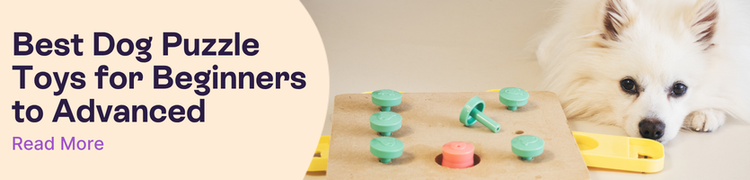
The Best Dog Puzzle Toys from Beginner to Advanced
Dog puzzle toys turn treat time into a problem-solving activity by encouraging your dog to sniff, nudge, slide or lift different parts to uncover a reward. The best choice is not necessarily the hardest one: it should provide enough of a challenge to hold your dog’s attention without leaving them frustrated.
Whether your dog is investigating their first puzzle or already makes short work of simpler designs, this guide will help you choose a suitable next step. We’ll look at some of the best dog puzzle toys for beginners, intermediate players and more experienced problem-solvers, along with how to introduce them and increase the difficulty gradually.
Reviewed by Hannah Nott BVSc MRCVS
Which Puzzle Difficulty Is Right for Your Dog?
Choosing the Right Puzzle Difficulty
- Beginner puzzles
Ideal for dogs new to puzzle toys, with visible treats and simple actions, such as lifting a flap or moving a single piece. - Intermediate puzzles
Best for dogs that have mastered basic puzzles, featuring multiple compartments, moving parts and combinations of actions. - Advanced puzzles
Designed for experienced puzzle-solvers, with multiple steps, hidden rewards and challenges that must be completed in a specific order.
How to Tell if a Puzzle Is the Right Level
- Use difficulty ratings as a guide, as levels can vary between brands.
- The best puzzle should challenge your dog while still allowing them to succeed.
- If your dog completes the puzzle very quickly and loses interest, they may be ready for a more difficult challenge.
- If your dog starts chewing, pawing aggressively or walking away, the puzzle may be too difficult.
- Consider trying an easier puzzle or a different puzzle style if your dog becomes frustrated.
What Are Dog Puzzle Toys and How Can They Help?
Dog puzzle toys hide treats, food or another reward behind covers, inside compartments or among different materials. Your dog then has to investigate the toy and discover how to reach what is hidden.
These toys can provide mental stimulation, encourage natural sniffing and foraging behaviours, and give dogs a focused activity when they are spending time indoors. Some food-based puzzles can also make mealtimes last longer by allowing dogs to work through their food gradually.
Puzzle toys work best as part of a varied routine that also includes suitable walks, training, play and rest. They do not replace physical exercise or time with you, but they can offer an enjoyable way for your dog to put their nose and problem-solving skills to work.
Best Beginner Dog Puzzle Toys
Beginner dog puzzles should make the connection between completing an action and finding a reward easy to understand. Simple puzzle boards can work well for dogs that enjoy lifting or nudging pieces, while soft foraging toys may appeal to those that prefer following their nose.
Nina Ottosson Dog Smart Puzzle Game
The Nina Ottosson Dog Smart Puzzle Game is a helpful starting point for first-time puzzle-solvers. Treats or pieces of kibble are placed in nine compartments and covered with removable bone-shaped pieces, which your dog must lift using their nose or paws.
You can leave some compartments uncovered and position the bones so they are easier to pick up during the first few attempts. Once your dog has cracked it, place the pieces flush with the board and cover more of the compartments.
Its adjustable setup makes this a practical introduction to puzzle boards. However, dogs with plenty of previous experience may work through its straightforward lifting action quite quickly.
Petface Fabric Snuffle Triangle for Scent-Led Play
The Petface Fabric Snuffle Triangle Pet Treat Puzzle Toy offers a different starting point for dogs that are more interested in sniffing and rummaging than lifting pieces from a board. Treats can be tucked into its fabric compartments, encouraging your dog to search through the different textures to find them.
For an easier introduction, place the rewards close to the openings where they can be found quickly. You can tuck them further into the folds once your dog understands the game.
The soft design and built-in squeaker may appeal to dogs that already enjoy fabric toys. However, it is not suitable for strong chewers, so the Dog Smart may be a more practical option if your dog is likely to bite through the material while searching. If you suspect your dog has swallowed sections of fabric, contact your vet as this can cause a blockage.
Best Intermediate Dog Puzzle Toys
Intermediate puzzles are suitable for dogs that already understand the basics of searching for a hidden reward. At this stage, you can introduce toys with combined movements or less obvious ways of reaching what is inside.
Nina Ottosson Hide N’ Slide Puzzle Game
The Nina Ottosson Hide N’ Slide Puzzle Game offers a natural step up from a straightforward lifting puzzle. Treats can be hidden beneath rotating flippers or placed inside sliding blocks, giving your dog two different actions to explore.
Begin by placing treats directly beneath the flippers, where they are easier to uncover. For a more involved challenge, hide the rewards inside the blocks so your dog must move them along the track before the treats are released.
The moving parts are fixed to the board, which may be helpful if your dog has a habit of carrying puzzle pieces away. The combination of swivelling and sliding makes it better suited to dogs that already have some puzzle-solving experience.
JW Hol-ee Roller X for Dogs That Prefer a Moving Puzzle
The JW Hol-ee Roller X Puzzle Ball may suit dogs that prefer chasing, gripping and pulling to working at a stationary board. Its open honeycomb design can be filled with suitable treats or small toys for your dog to work free.
The challenge can be varied by changing what you place inside and how easy it is to reach through the openings. Begin with rewards that protrude slightly, then introduce suitable items that require more careful pulling once your dog understands the activity.
This is a less structured puzzle than the Hide N’ Slide because there is no particular order for your dog to follow. However, it provides a more active alternative for dogs that lose interest when asked to remain in one place and move pieces around a board.
Best Dog Puzzle Toy for an Advanced Challenge
More advanced dog puzzle toys require greater persistence or several stages of investigation. They are best introduced once your dog can complete simpler activities calmly and without regular help.
KONG Ballistic Hide ’N’ Treat Dispensing Toy
The KONG Ballistic Hide ’N’ Treat Dispensing Toy uses fabric pockets and hook-and-loop fastenings to hide treats inside. Leave the pockets open for an easier search, or fasten them more securely so your dog must work out how to open each section.
For the greatest challenge, the toy can be completely closed into a ball. Your dog must open the outer shape before searching through the individual pockets for the hidden rewards. This gives you several ways to increase the difficulty without introducing a completely new toy.
This option may suit experienced, food-motivated dogs that enjoy pulling and unfolding soft toys. It is less likely to appeal to dogs that prefer nudging or sliding solid puzzle pieces.
How to Choose a Puzzle Toy for Your Dog
Once you have identified a suitable difficulty, consider the toy’s size, design and intended use. These practical details can make the difference between a puzzle your dog returns to and one that is quickly abandoned.
Think About How Your Dog Likes to Play
Watch how your dog naturally investigates toys and searches for food. Keen sniffers may prefer fabric folds and hidden pockets, while dogs that lead with their paws could enjoy sliders and rotating sections. Those that like carrying or chasing toys may be more interested in a puzzle ball than a stationary board.
Breed and age do not automatically determine the right type of puzzle. Previous experience, confidence and play style are usually more useful indicators, as well as how food motivated your dog is. Dogs with reduced mobility may benefit from a stable toy with pieces they can move comfortably.
Choose a Suitable Size and Design
Make sure the toy provides enough room for your dog to investigate and manipulate its different parts. A non-slip base may help enthusiastic players concentrate on the puzzle instead of pushing it across the floor, while a movable toy can be a better match for dogs that enjoy more active play.
Also consider whether you want removable puzzle pieces or a design with everything fixed in place. Removable pieces can provide an enjoyable lifting challenge, but fixed parts may be more convenient if your dog tends to carry individual pieces away.
Decide Between a Treat Puzzle and a Puzzle Feeder
A treat puzzle toy can be filled with a few small rewards for an occasional activity. A puzzle feeder should have enough capacity to hold a suitable portion of your dog’s usual food and release it at a manageable pace.
If you plan to use the puzzle feeder at mealtimes, check whether it is designed for dry food, wet food or both. Bear in mind how much food, either treats or kibble, is used in any toy and then reduce the amount of food is given in meals.
Check How Easy It Is to Clean
Food can collect around sliders, inside compartments and between fabric folds, so check the cleaning instructions before choosing a toy. Consider whether each area can be reached easily and whether the puzzle needs to be handwashed or can be taken apart for cleaning.
Always remove leftover food and allow the toy to dry fully before using it again.
How to Introduce Your Dog to a Puzzle Toy
A new puzzle can take a little practice, even if your dog is usually quick to investigate toys. Give them time to work out what is expected and make their first attempt easy enough to reward their curiosity.
- Choose a quiet place. Remove other toys and distractions so your dog can concentrate.
- Use an appealing reward. Add a few small treats or pieces of familiar kibble that your dog can easily smell.
- Let your dog investigate. Place the puzzle on the floor and allow them to explore it without immediately directing their paws or nose.
- Demonstrate one action if needed. Move a piece or uncover a treat so your dog can see where the reward is coming from, then let them try.
- Offer encouragement, not the answer. Calm praise can help maintain their interest, but avoid repeatedly completing the puzzle for them.
- Finish while it is still enjoyable. Keep early sessions short and put the toy away once your dog has found the rewards or begins to lose interest.
Some dogs will understand a new puzzle straight away, while others may need several short attempts. Give your dog time to become familiar with the activity before changing the setup.
How to Make Dog Puzzles More Challenging
If your dog begins completing a puzzle quickly, you may be able to adapt the existing toy before moving to a new level. Only use adjustments supported by the toy’s design and follow the manufacturer’s instructions.
Depending on the puzzle, you could:
- Fill and close all the available compartments.
- Position lifting pieces flush with the board.
- Introduce any built-in locks or additional steps.
- Fasten adjustable pockets more securely.
- Hide rewards more deeply within fabric folds.
- Rotate between different puzzle styles so the solution does not become too familiar.
A quick completion time is not the only sign that your dog is ready to progress. Look for them to solve the activity confidently on several occasions without becoming forceful or looking to you for help.
If they begin chewing components or tipping the entire toy over, they may need a different puzzle style rather than a harder version of the same activity.
How to Use Dog Puzzle Toys Safely
Puzzle toys should be treated as an activity rather than something your dog is automatically left to play with alone. Supervision is particularly important when they first use a new toy, as it allows you to see whether they are solving it as intended.
For safer puzzle play:
- Follow the manufacturer’s instructions and guidance on suitable dog sizes.
- Make sure individual pieces cannot be swallowed or become lodged in your dog’s mouth.
- Remove the puzzle if your dog begins biting, tearing or forcing its components.
- Check for cracks, loose pieces, damaged fabric or weakened fastenings before each use.
- Put the puzzle away once the activity is finished rather than leaving it available as a chew toy.
- Replace the toy if it becomes damaged.
No dog toy is completely indestructible. For more advice on matching toys to different sizes and play styles, read our guide to choosing the best dog toy.
Find Your Dog’s Next Puzzle Challenge
A puzzle has earned its place in the toy box if it keeps your dog curious, gives them a fair chance of finding the reward and leaves them keen to play again. Your dog may race through one design and take longer to understand another, so progress will not always follow a neat set of levels.
Offering different movements and ways to search can be just as valuable as choosing a harder toy. For more ideas beyond puzzle boards and treat-searching games, explore our guide to the best interactive dog toys for mental stimulation.
This post is an opinion and should only be used as a guide. You should thoroughly discuss any change to your pet’s care or lifestyle with your vet before starting any program or treatment. We update content regularly to reflect the latest pet health standards.
Hannah Griffiths
Senior Marketing Manager
Hannah Griffiths is the Senior Marketing Manager at Pet Drugs Online, overseeing content strategy and customer engagement initiatives. She is passionate about making pet health information accessible and easy to understand. Hannah collaborates closely with Pet Drugs Online's veterinary team, including Sarah Page-Jones, to help ensure all content is accurate, trustworthy and aligned with current veterinary best practice.